

Foguang Temple |A shed of light from the Tang Dynasty le
Shanxi itinerary |A First-Batch National Treasure and Tang-Dynasty Wooden Masterpiece—rare statue layout, timeless structure, and a crowd-free heritage route linked to Wutai Mountain and Nanchan Temple

Ancient Pines and Glazed Shadows
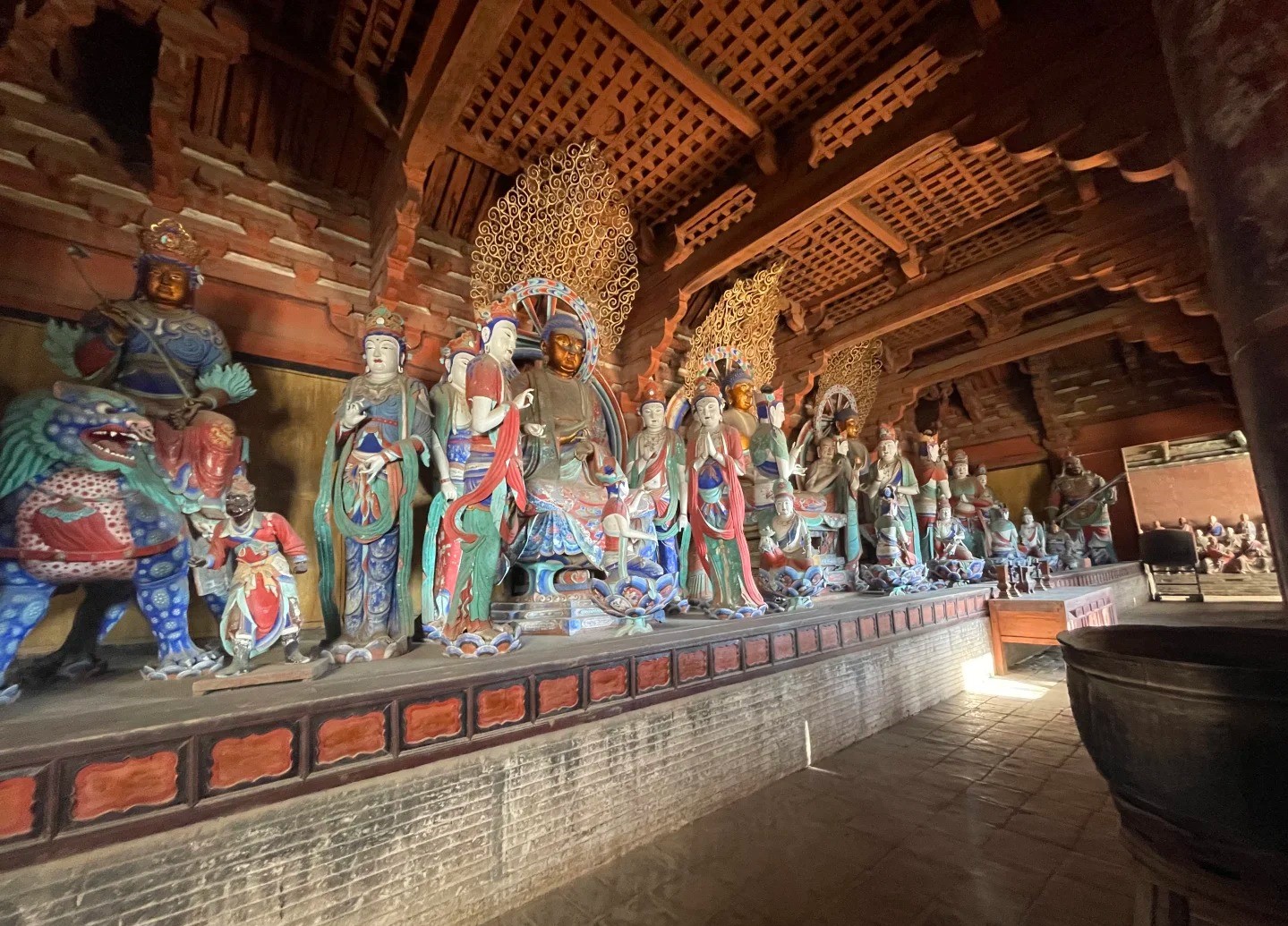
Climbing up from Dou Village, the temple appears between two ancient pines. The roofline stays quiet, but the bracket sets press downward with force—the corner dougong are vast, spreading like a Tang-style umbrella. Ancient texts once described eaves “flying like wings”; here, the phrase feels literal. Foguang Temple’s East Hall was rebuilt in 857 CE, and it has never undergone a full dismantling restoration—an almost impossible survival for timber architecture. Time left marks: cracked joints along the rear wall, a tilted foundation, even Tang-era lotus-base columns half buried by shifting soil. At sunset, gold light filters through pine needles, sketching shadows across the great wooden doors. For a few minutes each day, the entire hall glows—solemn, warm, alive.
Inscriptions and the Five Altars
Step onto the platform and face the proportions: seven bays wide, four deep, single-eaved hip roof; dense bracket sets linking outer and inner columns, coffered ceiling holding both tension and calm. Inside, architecture and art mirror one another. On the main altar stand over 30 polychrome clay figures, arranged in a rare trio—Amitābha Buddha, Śākyamuni, and the Seated Maitreya. At the gate, a Tang stele from the eleventh year of Dazhong (857) repeats the same order in low-relief. On the north wall, murals of Amitābha preaching complete the symmetry. Statues, stone carving, and wall painting form a single design—precise, unified, and still legible after twelve centuries. An inscription names the painter-sculptor: “Master Xu Qilang of the Red-and-White Academy.” In 1929 the abbot raised funds to repaint the figures, softening the Tang palette, yet the posture and gaze remain unmistakably of that era. Academic history folds in here too. In 1937, Liang Sicheng and Lin Huiyin confirmed the hall’s Tang origin through beam inscriptions matching the texts on the gate stele. Later, in 1964, Luo Zhewen—trapped here by heavy rain—noticed Tang-period ink writings on the door panels (dating as early as Xiantong 7, 866 CE) and uncovered Tang murals behind the central Buddha’s pedestal, proving the doors original. Across beam, stele, and statue, one donor’s name—Ning Gongyu—appears quietly, anchoring the story in both wood and time.
The Ridgeline and the Boundary Stone
If the East Hall did not exist, the Golden-Age Manjusri Hall would draw all eyes. From the East Hall, turn back and watch its ridge: a line that seems straight from afar rises into a gentle, elegant curve. Built in the tenth year after the Northern Song court fled south, the hall uses reduced columns to open a vast interior. Inside sits the Protector Manjusri, serene and precise. Behind the compound, scattered stupas mark ancient graves, and a weathered boundary stone still bears the temple’s name. If you have only half a day, spend your morning reading structure and symmetry in the East Hall, then walk down to see the Manjusri Hall’s flowing roof. The contrast between Tang restraint and Song-Jin grace says more than any guidebook.
Want to fold Foguang Temple into your Shanxi itinerary, linking Wutai Mountain and Nanchan Temple? Start with our free Journey Generator to map it out. Need precise advice on timing, etiquette, or photo angles? Connect with a verified local consultant — and turn seeing into understanding.